
Dr Cristina Stere
Energy Theme highlights: Probing the role of a non-thermal plasma (NTP) in the hybrid NTP-catalytic oxidation of CH4
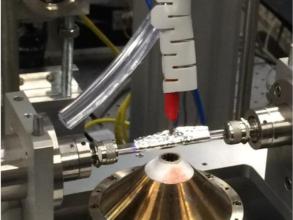
image credit: Dr Cristina Stere
The research started on the premises that there are mainly three hypotheses to explain the combined effect of NTP and catalysts: heating, modification of the catalyst or the ability of plasma to produce species that can open up new reaction pathways. Therefore, we have decided to investigate the plasma-assisted CH4 oxidation over a Pd/Al2O3 catalyst on the B18 beamline at Diamond. This allowed us to probe the structure and oxidation state of the Pd nanoparticle by X-ray absorption fine structure (XAFS), while constantly monitoring the reaction products by end of pipe mass spectrometry.
This in situ study has shown that the temperature of the Pd nanoparticle increased under plasma exposure but to values far below the ones required to activate the thermal CH4 oxidation reaction. Furthermore, no significant structural changes of the catalyst were detected under NTP conditions. Therefore, the most likely hypothesis to explain the observed synergy of in-plasma catalyst systems is the occurrence of an alternative methane activation pathway, through a lower activation barrier than the thermal activation reactions. This alternative pathway is proposed to be the activation of methane in the gas phase involving the formation of CH3(g) via electron impact reactions, leading to a reduced activation barrier for the surface process.
The team is now investigating other reactions to understand if the effect of the plasma changes with a different process.
Read more
More details of this study can be found in the full paper in Angewandte Chemie, DOI: 10.1002/anie.201703550
We would like to acknowledge the help and support provided by the staff on the B18 beamline of the Diamond Light Source.
Author
Dr Cristina Stere, Research Associate, School of Chemical Engineering & Analytical Science, The University of Manchester